


What is last-mile delivery and why it drives 50% of shipping costs
Discover what last-mile delivery is, why it dominates logistics budgets, and how AI-powered orchestration can slash costs while improving customer experience.

Andrey Golubinskiy
Co-Founder. Entrepreneur. Advisor.
 10 min
 7.4.2026
If you look at a logistics P&L, the final stretch of the journey often looks like a paradox. On paper, it is the shortest distance. In reality, it is where profit margins significantly decline.
There is a common trap in thinking that last mile delivery is just about moving a parcel from a local hub to a doorstep. Because it sounds simple, its complexity is often underestimated until you see the impact on the bottom line. Industry data from the Capgemini Research Institute consistently shows that last mile delivery costs can drive up to 50% of total shipping expenses. This isn't necessarily a sign of inefficiency; rather, it's the result of complex conditions where high operational volatility meets uncompromising customer expectations.
The "last mile" is the only part of the supply chain that has to deal with the chaos of city traffic, the unpredictability of human schedules, and the literal cost of a missed doorbell.
In this article, we'll break down what final mile delivery actually involves today and why it remains the most expensive bottleneck in logistics. More importantly, we'll explore how companies can navigate these last mile delivery challenges to reduce expenses without eroding the quality of service that keeps customers coming back.
What is last-mile delivery in simple terms
In logistics, the term "last mile" is often taken too literally, even though the actual physical distance is secondary. So in reality, what is the meaning of last mile delivery? It is less about miles and more about the final point of contact. It is that critical stage where a product leaves a controlled environment — such as a sorting hub or a local warehouse — and enters the complex, often unpredictable world of the end consumer.
While the "middle mile" focuses on the predictable movement of bulk goods between facilities, final mile delivery is where logistics becomes granular. At this stage, it's no longer just a game of volume; it's a game of circumstances: navigating city traffic, finding parking, and managing precise delivery windows.
To ensure your last mile delivery service operates smoothly, it must synchronize three fundamental pillars:
- Intelligent Planning: This goes beyond a simple line on a map. It involves dynamic dispatching — understanding which driver can reach a specific neighborhood by 2 PM and which vehicle has the right capacity for a specialized order.
- Real-time Execution: This is where your last mile delivery process meets reality. It requires active fuel management, live navigation, and the ability for drivers to adapt to on-the-go changes without losing momentum.
- Proactive Communication: High-quality delivery is impossible today without transparency. If a customer doesn't have an accurate ETA, the risk of a failed delivery attempt increases, along with your operational overhead.
Whether you are handling grocery orders from a supermarket or managing a retail ship-from-store model, last mile delivery is the ultimate litmus test for your efficiency. Without a direct, real-time link between the dispatcher and the courier, this process can quickly shift from a business asset to a primary source of loss.
Why last-mile delivery is the most expensive part of shipping
Why does moving a parcel across an ocean cost nearly the same as moving it the last five miles to a suburban doorstep? The answer lies in the total loss of scale; while long-haul shipping thrives on consolidation, the last mile is where efficiency shatters into thousands of unpredictable, individual variables.
Most industry research suggests that last mile delivery costs typically fluctuate within a range of 41% to 53% of the total shipping price. It is rarely a static figure, as it depends heavily on geographic density and service levels, but the "up to 50%" benchmark remains a sobering reality for most retailers. This massive spend isn't usually the result of one single failure, but rather an accumulation of small, overlapping operational inefficiencies.
Fragmented routes and low drop density
In the middle mile, a truck moves between two hubs with a full load and zero interruptions. In the final mile delivery, that same volume is split across multiple vans that have to stop fifty times. Each stop — idling in traffic, hunting for a parking spot, and the literal walk to the porch — eats into the margin. When routes are fragmented and drivers are forced to crisscross town for a few isolated drops, you aren't just paying for delivery; you are paying for the "empty miles" and wasted time between customers.
The hidden drain of manual planning
Even today, many fleets still rely on semi-manual dispatching or static routes that ignore the reality of the morning rush. Manual planning is inherently rigid. If a driver gets stuck in a sudden gridlock or a vehicle breaks down, a manual system cannot recalculate the entire fleet's logic on the fly. This lack of agility leads to unnecessary mileage and overtime, which directly inflates the last mile delivery cost.
The "Where Is My Order?" (WISMO) support tax
An often overlooked part of the cost is the strain on the back office. When a last mile delivery service is opaque, customers flood call centers with inquiries. This "support tax" adds a significant administrative layer to every parcel. Transitioning to last mile delivery digitization — where the customer has a live tracking link and an accurate ETA — is often the only way to kill this specific overhead.
High "Failed-to-Deliver" (FTD) rates
The most expensive delivery is the one you have to do twice. Every time a driver arrives at a closed gate or finds no one home, the cost of that order effectively doubles. Without last mile delivery automation that sends proactive reminders or allows customers to change delivery windows mid-route, companies end up burning fuel and labor on "ghost" attempts that yield zero revenue.
The complexity of "White Glove" and assembly services
Modern last mile delivery trends show that customers now expect more than just a box on the porch. Services like furniture assembly, appliance installation, or grocery "inside-the-fridge" delivery add massive time-per-stop. Managing these specialized tasks requires a level of last mile delivery innovation that standard routing tools can't handle, often leading to skewed schedules and cascading delays across the entire fleet.
Urban access and "Zero-Emission" compliance
As more European cities implement zero-emission zones and strict time windows for heavy vehicles, the last mile delivery market is becoming a regulatory minefield. Navigating these restrictions without smart software leads to heavy fines or the need for expensive, specialized electric fleets. If your planning doesn't account for these hyper-local constraints, you are essentially paying a "compliance tax" on every city-center route.
Common last-mile challenges companies underestimate
It is easy to fixate on visible problems like rising fuel prices or traffic jams, but the real margin-killers in the final stretch are often invisible until you audit the entire operation. Most logistics managers underestimate the sheer weight of "exception handling" — those chaotic moments when a delivery goes off-script and requires immediate human intervention. To solve this, one must first understand what is the last mile delivery problem in its practical sense: it's the point where theoretical planning meets the unpredictable reality of the street.
The nightmare of dispatch complexity
Many operations teams still view dispatching as a basic game of Tetris: you just cram boxes into a van and hope for the best. In reality, modern high-volume dispatching is an extremely complex optimization task. It's never just about cubic meters; it is about balancing driver burnout, hyper-specific delivery windows for VIP clients, and the sudden, inevitable vehicle breakdown mid-route.
When you try to manage this complexity manually — or through legacy software — the whole system eventually fails to maintain efficiency. This is why many companies are transitioning to a dedicated final mile delivery service model that uses automation to bridge the gap. You end up with skipped deliveries and expensive re-routing that directly erodes your daily profit. Without modern final mile delivery logistics, your scaling efforts will only lead to higher overheads and lower customer satisfaction.
Lack of visibility into real operational cost drivers
Ask a logistics lead exactly how much a single failed drop at 4 PM on a Friday costs their business, and most logistics managers cannot answer this question with precision. Without deep last mile delivery digitization, most fleets operate on "averages," which is a dangerous way to measure unit economics.
Managers often miss the granular expenses — the ten minutes a driver spends circling a one-way street for parking or the fuel wasted idling at a closed gate. If you aren't measuring these friction points down to the second and the cent, you aren't really seeing where the last mile delivery problem actually begins.
The "Experience Gap" in the final mile
There's a clear disconnect between a parcel being physically dropped on a porch and a customer actually feeling satisfied with the service. A classic last mile delivery challenge is the total disconnect between the warehouse's internal metric (getting the box out the door) and the recipient's reality (knowing exactly when that door will ring).
If a driver pulls up even ten minutes outside a promised window — and there was no proactive alert — that customer's trust simply evaporates. Spending thousands to rebuild brand loyalty through marketing is far more costly than implementing reliable last mile delivery route optimization logic to prevent these failures in the first place.
Shrinking margins due to fleet scaling
There is a persistent myth that if you can handle 50 deliveries, you can handle 5,000 just by throwing more vans at the map. It doesn't work that way. As volume climbs, the complexity of the last mile delivery market doesn't grow linearly — it grows exponentially. Every new vehicle adds a hundred new "what-if" variables.
Without some form of last mile delivery automation, you eventually reach a point where you're forced to over-expand your dispatch team just to manage the operational chaos. This is a common scaling challenge that keeps mid-sized logistics firms from becoming profitable.
What to look for in last-mile delivery software
Choosing a software for final-mile operations is rarely about finding a pretty dashboard; it is about finding an operational brain. In fact, many platforms perform well in a controlled demo environment but quickly fall apart when they hit the "noise" of real-world logistics. To ensure any kind of long-term ROI, decision-makers have to evaluate software based on how it orchestrates chaotic, multi-layered workflows in real time.
The ability to manage true operational complexity
Basic routing tools often hit a ceiling the moment a fleet grows or the constraints become more specific. A professional last mile delivery platform must do more than just map a route; it has to simultaneously account for vehicle weight capacities, driver shift laws, and specialized cargo requirements like temperature control.
Ideally, the system should distinguish between various transport modes — from a bike courier in a pedestrian zone to a heavy truck on a suburban highway — without requiring a human to intervene and fix the logic manually.
Real-time decision-making, not just visualization
Visibility alone is no longer a competitive advantage. While many legacy tools provide a "live map," they often remain passive — they show you a delay, but they don't solve it. Advanced last mile delivery automation tools should offer active orchestration.
This means automatically recalculating paths or re-assigning tasks the second a disruption is detected. The goal here is to drastically reduce the cognitive load on your dispatchers by letting the software handle the routine exceptions of the day.
Scalability across different volumes and regions
A common "scale trap" is picking software that works for a local pilot project but fails during a rapid national expansion. Your platform must be able to handle massive volume spikes — think peak seasons or pre-holiday periods — without any performance degradation.
Beyond just volume, it should support multi-regional deployments that factor in local time zones, specific urban access laws, and diverse address formats. True last mile delivery innovation should act as a catalyst for your growth, not a technical barrier that stops it.
Integration that works (OMS, WMS, TMS)
Logistics doesn't happen in a silo. Your delivery software is only as good as the data it gets from your Warehouse Management System (WMS) or Order Management System (OMS). Look for "API-first" platforms that can sync in milliseconds. When a customer clicks "buy," that order needs to flow into the last mile delivery process instantly to allow for immediate slot booking. If you are still manually uploading CSV files at the start of every shift, you are already losing money to inefficiency.
Native support for same-day and dynamic scenarios
The last mile delivery market is shifting toward on-demand expectations. This requires a level of agility where new orders are injected into existing routes while drivers are already on the road. If your current software requires you to "close" or "freeze" a route before the van leaves the hub, you won't be able to compete in the world of same-day delivery. Dynamic, "on-the-fly" routing is the only way to satisfy the modern consumer without destroying your delivery margins.
How VanOnGo improves last-mile delivery
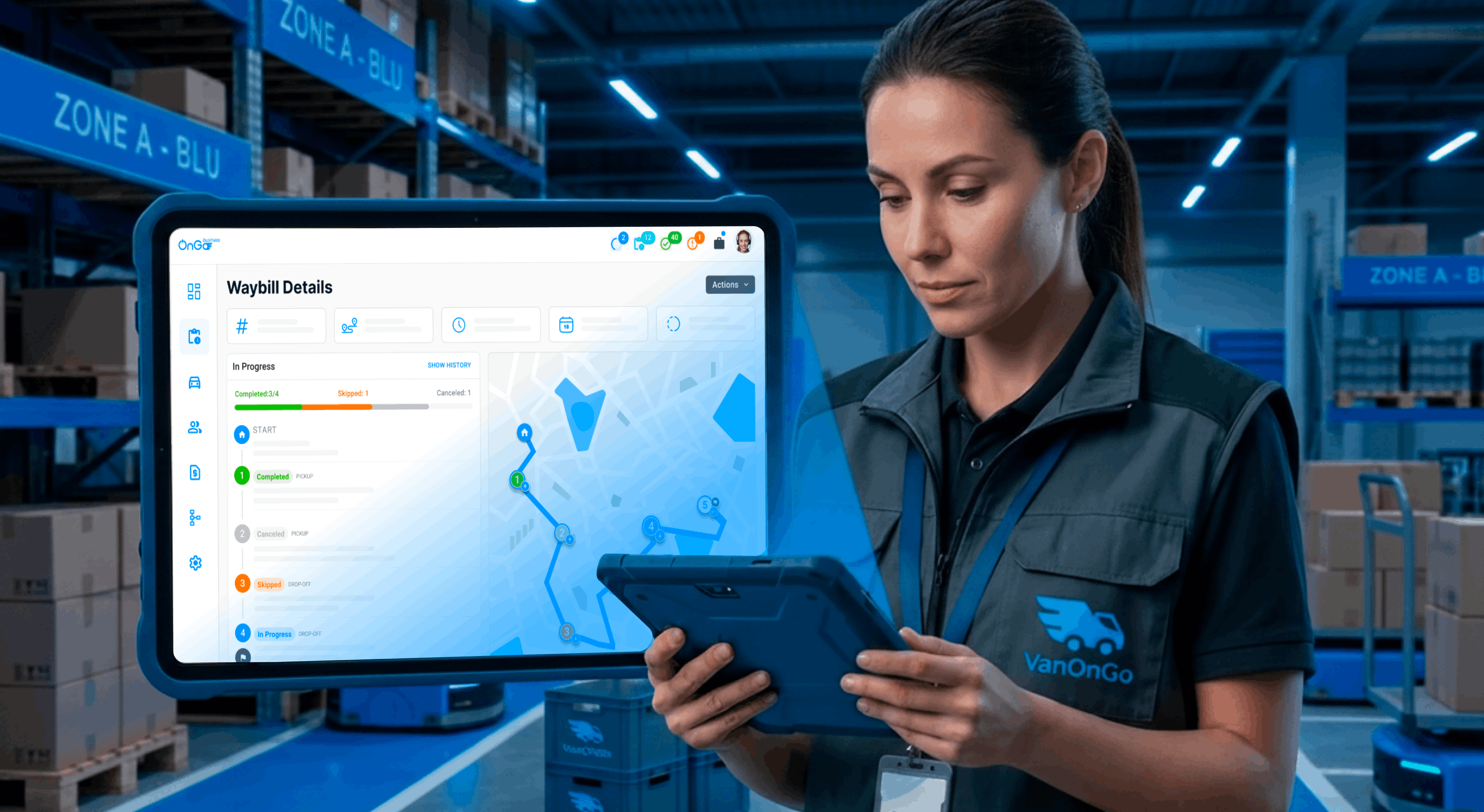
While many platforms merely track deliveries, VanOnGo acts as a high-performance orchestration layer designed to handle the high volatility and unpredictability of the final mile. It moves beyond simple visualization by using an AI-powered and Quantum-inspired logistics engine that doesn't just plan routes — it solves them in real-time. By automating the most complex parts of the last mile delivery process, VanOnGo allows businesses to cut operational costs by up to 25% while simultaneously improving the customer experience.
The platform effectively eliminates the "static planning" problem by offering:
- AI-Driven Orchestration: A sophisticated decision-making layer that handles auto-dispatching and manages exceptions without requiring manual human intervention.
- Precision Dispatching: The system allows a single dispatcher to handle over 5,000 orders per day, significantly reducing the administrative overhead that usually inflates last mile delivery costs.
- High First-Attempt Success: Through proactive customer notifications and live branded tracking, VanOnGo achieves a perfect 100% first-attempt delivery rate (up from a 91% baseline), killing the "double cost" of failed drops.
- Dynamic Adaptability: Whether it is managing EV-only access zones or adjusting to sudden traffic changes, the software ensures that last mile delivery route optimization remains active until the parcel is in the customer's hands.
VanOnGo doesn't just offer a tool; it provides a highly scalable delivery platform that helps growing fleets and large retailers prevent operational cost-leakage and build long-term customer loyalty through reliable delivery.
-> Protect Your Margins Against Rising Last-Mile Costs ->> Explore how VanOnGo's orchestration helps you manage increasing delivery volumes without compromising on reliability. [Book a Demo]
FAQ
- What is final mile delivery?
It is much more than the final drive to a doorstep. It represents the entire complex orchestration of planning, dispatching, and live communication needed to get a parcel from a hub to a customer. Essentially, it's the most volatile and expensive stage of the supply chain where your operational efficiency either builds or breaks customer trust.
- Why are last mile delivery costs consistently so high?
Because you lose the "economy of scale" found in long-haul shipping. Instead of one truck going to one warehouse, you have dozens of vans making fifty individual stops in city traffic. These variables, combined with failed attempts and the time drivers spend hunting for parking, can easily drive up to 50% of your total shipping spend.
- What is a last mile delivery station in practice?
Think of it as a specialized local sorting hub or a "micro-fulfillment center." It's where bulk shipments are broken down into individual orders for final courier dispatch. These stations are the key to enabling same-day or 60-minute delivery by moving the inventory closer to where the customers actually live.
- How long does last mile delivery take today?
It depends entirely on the service level you promise. It can range from a 30-minute express grocery drop to a standard 24-hour next-day window. With proper last mile delivery route optimization, the goal is to make these windows as narrow as possible to ensure the customer is actually home when the driver pulls up.
On this page
Let`s talk!
Loading form...